Major Takeaways
What’s the best MoltSets alternative? Limadata, for most teams. It’s the closest match on the things that drew people to MoltSets in the first place – API-first, MCP-native, published per-operation pricing, no seats – while solving the three things MoltSets can’t yet: you can sign up today without an application, the coverage is international rather than US-only, and the data is queried live at request time rather than served from a periodic rebuild.
Why do teams look for a MoltSets alternative at all? Rarely because of the data. At $27/month MoltSets is the cheapest entry point in this category, and the underlying asset is RB2B’s, not a first attempt. Teams look elsewhere because they can’t get in – it’s still closed beta behind an application form – and because US-only coverage rules out a large share of real ICPs.
Is MoltSets pricing actually unlimited? Not quite, and the gap is bigger than it sounds. A published fair use policy caps enrichment at 5,000 records a week on the $27 plan – roughly 21,700 a month, which is almost exactly what Limadata’s 20,000-credit Pro plan allows at $200. That’s a real and large price advantage, but it’s a price advantage, not the absence of a limit.
When is MoltSets still the right choice? When all four conditions hold at once: you already have beta access, your ICP is entirely US-based, your workload is bulk email enrichment rather than anything event-triggered, and you don’t need mobile numbers at volume. That’s a narrow intersection, and it’s the reason most teams evaluating MoltSets end up needing a second provider alongside it anyway.
Key Takeaways
- Limadata is the strongest overall alternative for real-time enrichment across AI agents, recruiting, and GTM, with published per-endpoint pricing, international coverage, and a free tier that returns real values today
- Mobile numbers are where the flat rate breaks down – MoltSets meters them separately as tokens at $0.20–$0.50 each, well above Limadata’s $0.10 per mobile at Pro rates
- A weekly refresh is not a change feed – if your workflow fires on an event rather than asking what’s currently true, no refresh rate substitutes for a signal layer
- Review volume is thin across this whole category – most of these tools have well under 30 G2 reviews, because they’re APIs bought by engineers rather than seats bought by sales teams; weigh a free-tier test above any rating
- Match the model to the workload: bulk warehouse ingestion, real-time agent enrichment, and database-wide cleanup are three different purchases, and no single vendor wins all three
What Is MoltSets and Why Look for Alternatives?
MoltSets is an API-only B2B search and enrichment product from Adam Robinson, the bootstrapped founder behind Retention.com and RB2B, and it’s funded from those businesses rather than outside capital. The pitch is deliberately narrow: no dashboard, no dialer, no sequencer, no seats – just a set of contact data APIs and an MCP server you call from Clay, Claude Code, Codex, n8n, or your own stack. The commercial model is the differentiator. Instead of per-lookup credits, you buy a flat monthly plan that includes unlimited access to the core data asset, which removes the cost-explosion problem that makes people nervous about pointing an autonomous agent at a metered API.
It’s a genuinely good offer, and the underlying database isn’t a startup’s first attempt at one – it’s the asset RB2B has been maintaining for years. Teams don’t look elsewhere because the product disappointed them. They look elsewhere because they can’t buy it yet, or because it doesn’t cover their geography, or because their workload needs freshness or phone numbers that the flat rate doesn’t stretch to.
Key MoltSets strengths:
- Flat, tier-based pricing from $27/month with unlimited enrichment records inside the plan’s rate limits – the cheapest entry point in this comparison by a wide margin
- 20+ vendor email waterfall, with in-house records first and external vendor fallback when a record isn’t held
- Email risk scoring on an A–F scale, built as a response to Microsoft’s Spring 2026 blocking of SMTP-based validation, which started producing false “invalid” results across the whole validation industry
- Real-time carrier verification on every mobile number
- MCP-native at
mcp.moltsets.com/mcp, with a consistent request shape and response envelope across every endpoint - Thoughtful free endpoints – account, billing, and usage checks, plus
count_onlysearch that returns a result count before you commit to fetching – and batch enrichment up to 100 values per call - Ad audience endpoints – business email to SHA256, LinkedIn to SHA256, email to MAID – for ABM on Google, Meta, LinkedIn, and TikTok
- Database refreshed every 7 days, with job changes processed every 2 weeks, and dead or non-workforce LinkedIn URLs filtered out
- SOC 2 Type 1, SOC 2 Type 2, and CCPA compliant, with opt-out handled through parent company Retention.com
- No contracts, no annual commitment, no per-seat pricing – cancel from billing settings at any time
MoltSets limitations:
- Still in closed beta. Access runs through an application form rather than self-serve signup. You cannot adopt it on demand today, which is disqualifying if you have a workload to ship this week.
- US data only at launch. EMEA, APAC, and Canada are targeted for end of Q3 2026 but aren’t live. Every other tool in this comparison has international coverage now.
- “Unlimited” has a published ceiling. The fair use policy caps enrichment at 5,000 records a week on $27, 75,000 on $97, and 900,000 on $997, with search capped at half those numbers. That’s a lot of records for the money, but a team modelling capacity should use the weekly cap, not the word “unlimited.”
- Mobile numbers sit outside the flat rate. They’re metered as phone tokens, with only 10, 50, and 250 included on the three paid tiers. Extras run $0.50 each in small bundles down to $0.20 at 10,000. MoltSets is explicit about why – real-time carrier verification is an expensive per-unit cost – but it means phone-heavy workloads price out well above the headline.
- A snapshot, not a change feed. The 7-day rebuild is genuinely good for a database product, but job changes are only processed fortnightly, and a periodic snapshot can tell you what’s true now while never telling you that something changed. There’s no job-change webhook, funding alert, or hiring-spike trigger – search, enrich, validate, and reverse lookup is the whole surface, by design. For batch prospecting that’s fine; for anything that fires on an event, it’s the product.
- Beta and alpha endpoints. The popular contact endpoints are marked beta and the search endpoints alpha, which is honest labelling but is worth reading literally before putting them behind revenue.
- Self-reported coverage. MoltSets describes its return rate as on par with other vendors based on customer tests and encourages you to run your own comparison. There’s no published benchmark.
- No refunds on purchases or renewals, and one account per domain.
- The top tier is a co-marketing arrangement. The $997 Unlimited plan is listed alongside posting twice a month tagging MoltSets on LinkedIn, with founder amplification in return – which makes it a promotional rate rather than a clean list price.
MoltSets reviews: No rating available – no G2, Capterra, or Trustpilot presence, which is expected for a product still in closed beta.
None of that is about data quality. Every tool below solves at least one of those gaps, and most are available to buy this afternoon.
How We Compared These Tools
Every pricing figure came from the vendor’s own pricing page, captured September 2026, with per-endpoint credit costs from vendor docs and ratings from G2, or the most credible public source where a vendor has no G2 profile. Where no public pricing exists, we say so rather than citing third-party estimates.
Pricing pages change often, so verify before you buy.
MoltSets Alternatives at a Glance
| Tool | Best for | Free tier | Entry price | 10,000 work emails/mo | Rating |
|---|---|---|---|---|---|
| Limadata | Real-time enrichment for AI agents, recruiting, and GTM | 100 credits, 500 on demo | $50/mo | $100 | 5.0 |
| Crustdata | Live signals and event watchers | None – sales call required | Not published | Not published | 4.4 |
| LeadMagic | Pay-per-result with published pricing | None | $49.99/mo | $249 | 4.3 |
| Landbase | Natural-language audience building | 1,000 credits, no expiry | $499/mo | $499 | 4.5 |
| Enrich Layer | Pay-as-you-go without a subscription | None | $10 pay-as-you-go | $899 | n/a |
| CompanyEnrich | Company firmographics on a budget | 500-credit trial | $49/mo | $549 | 4.8 |
| Explorium | Multi-source data for GTM agents | 100 credits, 90 days | $99.99 one-time | $750 one-time | 4.6 |
| Coresignal | Warehouse-scale bulk datasets | 2,000 credits, 7 days | $49/mo | $1,500 | 4.5 |
| People Data Labs | Raw person data at scale | 100 credits/mo, no contact data | $98/mo | Enterprise quote | 4.3 |
| MixRank | Enriching an existing B2B database | Free data sample | $1,000/mo, annual | Not offered | 3.8 |
| MoltSets | Flat-rate unlimited (closed beta, US-only) | 1,000 records lifetime | $27/mo | $27 | n/a |
The fifth column prices every vendor on the same job: 10,000 verified work emails in a month, on the cheapest plan that can actually deliver them. MoltSets wins that column at $27 – but only for a US-only, email-only workload you can actually get access to, and only for emails, since mobile numbers are metered separately on top. Among tools you can buy self-serve today, Limadata is the cheapest at $100 – a work email is one credit at $0.01, so 10,000 of them costs exactly that, with no unused plan headroom – and it’s the only option at that price with live data, international coverage, and a signal layer.
The one thing worth knowing about that $27 is that “unlimited” means no per-lookup charge, not no limit. A fair use policy caps the plan at 5,000 enrichment records a week – roughly 21,700 a month, which is close to what Limadata’s 20,000-credit Pro plan allows. The price gap is real and large. The volume ceiling isn’t. If you’re building something that runs on its own rather than enriching lists by hand, the $97 plan is the fairer comparison.
The 10 Best MoltSets Alternatives
1. Limadata: Best for real-time data enrichment for AI agents, recruiting, and GTM
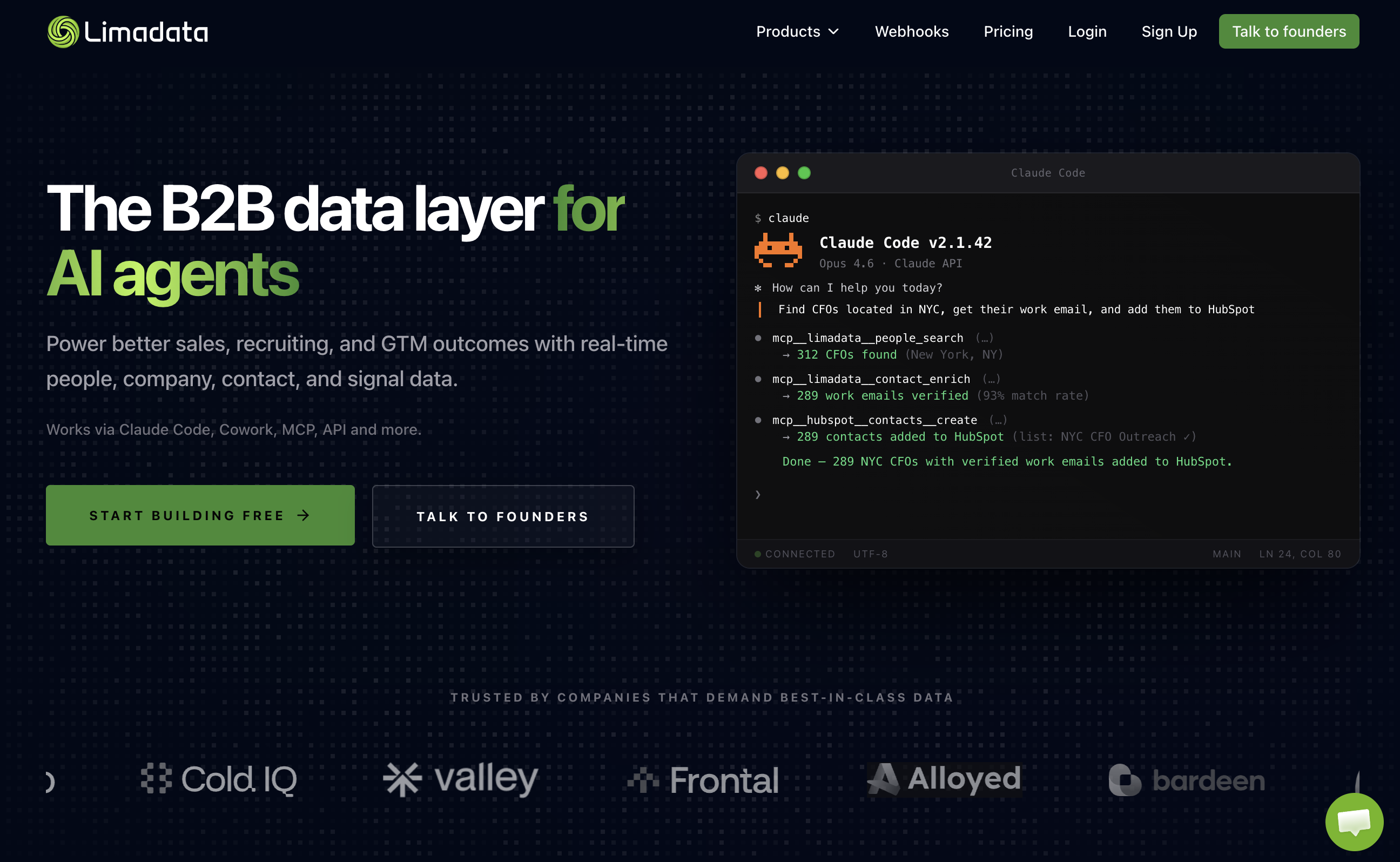
Limadata inverts the database model that MoltSets and most of this category rely on. Instead of serving records from a store that’s refreshed on a cycle – every 7 days in MoltSets’ case, monthly in several others – it queries multiple trusted sources on demand and cross-references them at request time. That matters most where accuracy isn’t negotiable: an AI sales agent querying Limadata the moment a prospect hits your site gets their current title and latest funding round in milliseconds, which is what lets it open with the new VP role and the Series B rather than something from the last refresh. The same model powers Watch alerts, so a recruiting platform can be notified the instant a tracked candidate changes jobs. Access is available through the API, webhooks, an MCP server, Claude Code, and Cowork.
Key Limadata advantages:
- 50+ endpoints, one of the most robust sets available from any provider in this comparison, against MoltSets’ deliberate five
- 550M+ contacts and 60M+ companies, growing continuously rather than on a batch refresh cycle
- International coverage today – no waiting on a regional roadmap to serve accounts outside the US
- Available self-serve right now – sign up and call the API without an application form or a waitlist
- Excellent personal email coverage – ranked #2 among personal email providers in Clay’s waterfall, a category most API-first providers don’t compete in at all
- Watch API with webhooks for job changes, promotions, funding events, and hiring spikes – the signal layer MoltSets doesn’t offer at all
- Hashed email and ad audience endpoints for building match-ready audiences on ad platforms, one of the few places these two products directly overlap
- Flat file delivery available alongside the API, for teams that want to load data directly rather than call endpoints
- Hands-on support with features built on request – several endpoints exist because customers asked for them, and reviewers consistently cite responsiveness as a reason they stayed
Limadata pricing structure:
- Free: $0/month – 100 credits (up to 100 work emails, 10 mobile numbers), or a 500-credit trial for qualified demos
- Starter: $50/month – 2,500 credits at $0.02/credit
- Pro: $0.01/credit, sized to your volume – 10,000 credits for $100/month, 20,000 for $200, and steps at 50,000, 70,000, and 100,000
- Enterprise: Custom – batch endpoints, custom rate limits, annual credit expiration
Per-endpoint credit costs – person enrich 1, company enrich 1, work email 1, mobile 10, web search 0.1, extract 0.1, company jobs 2 – are published in full on the Limadata pricing page, along with top-ups at 150% of plan rate for months you run over.
Limadata limitations:
- Credit-based, not flat-rate. If the thing you value most about MoltSets is never having to think about per-call cost again, Limadata is a different model and won’t give you that. Published per-endpoint rates and top-ups make a workload straightforward to model in advance, but you are still modelling it.
- Entry price is higher. $50/month against $27, and a 10,000-email workload runs $100. You’re buying live data, international coverage, and a signal layer with that difference, but it is a real difference.
- You need to be comfortable working with an API. Limadata is infrastructure rather than a list-building UI. That doesn’t mean you need an engineering team – connecting the MCP server to Claude is enough to start querying live data in plain language – but if you want a point-and-click prospecting tool, this is a lower layer of the stack than you’re looking for.
Limadata reviews: 5.0/5 on G2 (5 reviews).
Best for: Teams building AI agents, running recruiting workflows, or powering GTM motions that need people, company, contact, and signal data live at query time, with transparent per-operation pricing and coverage outside the US.
2. Crustdata: Best for live signals and event watchers
Crustdata is an API-first B2B data platform for developers and AI agents, aggregating continuously from live sources rather than serving periodic database refreshes. Where MoltSets is built around cheap, high-volume lookups against a weekly snapshot, Crustdata is built around knowing when something changed. Its watcher endpoints monitor companies and people and fire webhooks on job changes, funding rounds, and hiring events, with tiered refresh frequencies down to daily. The company reported crossing $10M ARR in 2026, having grown from $600k in eighteen months.
Key Crustdata advantages:
- Watcher endpoints with webhook delivery for job changes, funding, and hiring events – the single biggest capability gap versus MoltSets
- Tiered watcher refresh frequency, from 30-day down to daily
- Live aggregation rather than batch refreshes, against a base of over a billion people and 60 million companies
- Company screening across 250+ firmographic criteria, people profiles with 90+ datapoints
- Additive enrichment pricing – you pay for the base profile, then only for the fields you request
- Free autocomplete and company identify endpoints
- Low-cost discovery – search bills at 0.03 credits per result, and returning nothing costs nothing
- Flat file datasets refreshed monthly, unified from 11+ sources, delivered as CSV or JSON
Crustdata pricing structure:
Crustdata’s pricing page describes credit-based usage tiers with monthly and annual payment options, plus separately quoted flat file datasets and custom enterprise solutions, but publishes no tier prices. Plan costs require a demo call.
Crustdata limitations:
- No self-serve plans and no free tier. There’s no way to sign up and start calling the API. Evaluating Crustdata means booking a sales call and being qualified first – a much heavier lift than MoltSets’ application form, and far heavier than most of this list.
- No published pricing. You cannot model what a workload will cost before talking to a rep, which is the inverse of what draws people to MoltSets in the first place.
- Enterprise-only endpoints. Contact enrichment, batch contact enrichment, social post search and enrich, developer platform data, and employee review data all require an enterprise contract – which makes it a poor straight swap for a contact-enrichment workload.
- Plan-gated live endpoints. Live Company and Person endpoints need the right plan; only Web Search and Web Fetch are guaranteed on self-serve.
- Credits expire after six months from purchase date.
- Documented pricing volatility. Crustdata’s own docs warn that pricing can change by plan, entitlement, and endpoint version, and advise confirming costs before planning production usage.
Crustdata reviews: No G2 profile. 4.4/5 on Product Hunt.
Best for: Teams whose scoring or routing logic depends on live company and people signals, and who can absorb a sales-led buying process to get them.
Limadata Alternative: Limadata Pro
3. LeadMagic: Best pay-per-result pricing transparency
LeadMagic offers verified emails, mobile numbers, company intelligence, and hiring signals through an API, a terminal CLI, and a hosted MCP server. It’s the closest spiritual match to MoltSets on this list – API-first, agent-friendly, aggressively priced, with everything published on one page – but it’s generally available, internationally covered, and considerably cheaper per mobile number.
Key LeadMagic advantages:
- Low mobile number costs at 5 credits each, which undercuts MoltSets’ token pricing at every bundle size
- Credits deducted only on successful results – failed matches cost nothing
- Search spends no credits on Essential and above; Professional and Ultimate add an unmetered search API
- Credit rollover up to two months banked on Essential and above
- MCP server and CLI included on every plan, including the cheapest
- 15+ endpoints on one shared credit pool and a single API key
- Efficient credit costs: email 1, mobile 5, validation 0.25, employee finder 0.05
LeadMagic pricing structure:
- Basic: $49.99/month ($490/year) – 2,000 credits/month, 1 seat, search not included
- Essential: $99/month ($990/year) – 5,000 credits/month, 3 seats, search included
- Growth: $249/month ($2,490/year) – 20,000 credits/month, 5 seats
- Professional: $499/month ($4,990/year) – 50,000 credits/month, unmetered search API
- Ultimate: $849/month ($8,490/year) – 100,000 credits/month
- Enterprise: From $2,490/quarter
LeadMagic limitations:
- No free tier. You can’t evaluate the data without paying first. Note that several third-party sources – and at least one page on LeadMagic’s own site – still reference 100 free credits; that offer has been discontinued, and the pricing page FAQ is the current source of truth.
- No rollover on Basic, and search isn’t included at that tier either, which makes the entry plan noticeably weaker than its price implies.
- Inconsistent results across lists. User ratings cluster at the extremes rather than the middle, which suggests it performs well on most lists and poorly on some. Worth testing against your own data before committing.
- Per-seat limits exist, unlike MoltSets, where any key can be used by anyone on the domain.
- Contact-data focus. Less firmographic depth than a dedicated company data provider.
LeadMagic reviews: 4.3/5 on G2 (19 reviews).
Best for: Outbound teams and developers who want verified contact data with genuinely predictable published costs, and anyone whose workload is mobile-heavy.
Limadata Alternative: Limadata Starter
4. Landbase: Best for natural-language audience building
Landbase is the closest structural analogue to MoltSets on this list: rather than owning a first-party dataset, it routes enrichment through 20+ providers automatically and returns the first verified result – the same waterfall pitch, built on a different commercial model. It’s an agentic GTM platform where you describe an ideal customer profile in plain language and it maps the addressable market and exports a qualified audience. It’s powered by GTM Omni, an in-house model for go-to-market automation, and raised a $30M Series A in July 2025.
Key Landbase advantages:
- Waterfall routing across 20+ providers, which typically beats any single source on match rate
- Search, lookalike expansion, and misses are all free – you’re charged only for verified results
- 1,000 free credits with no credit card and no expiry, the most generous no-strings free tier here
- CLI built for terminal and agent workflows, with JSONL, CSV, and Parquet exports – a natural fit if you came to MoltSets from Claude Code or Codex
- Buying signals including funding, hiring surges, leadership moves, and tech adoption, computed from 1,500+ enrichment fields
- Named a Gartner Cool Vendor in AI for Marketing (2025)
Landbase pricing structure:
- Free: $0 – 1,000 credits, no card, no expiry
- Tier 1: $499/month – 15,000 credits at $0.033/credit
- Tier 2: $1,999/month – 75,000 credits at $0.0267/credit
- Tier 3: $4,999/month – 200,000 credits at $0.025/credit
- Enterprise: Custom
Landbase limitations:
- Highest entry price among self-serve options at $499/month – roughly 18× MoltSets, and ten times Limadata, CompanyEnrich, or LeadMagic.
- Shallowest volume discount here – only 1.3× from entry to top tier, so scaling up barely improves your rate.
- Aggregator, not a data owner. Coverage and cost depend on the underlying providers, which is a dependency worth understanding.
- Mobile numbers cost 10 credits at $0.33 each, the most expensive mobile pricing in this comparison.
- Plans are unnamed, and the free credit allowance is described inconsistently across their own site.
Landbase reviews: 4.5/5 on G2.
Best for: Sales, marketing, and RevOps teams who want to define an ICP and map total addressable market conversationally, with waterfall enrichment running behind it.
Limadata Alternative: Limadata Pro
5. Enrich Layer: Best pay-as-you-go without a subscription
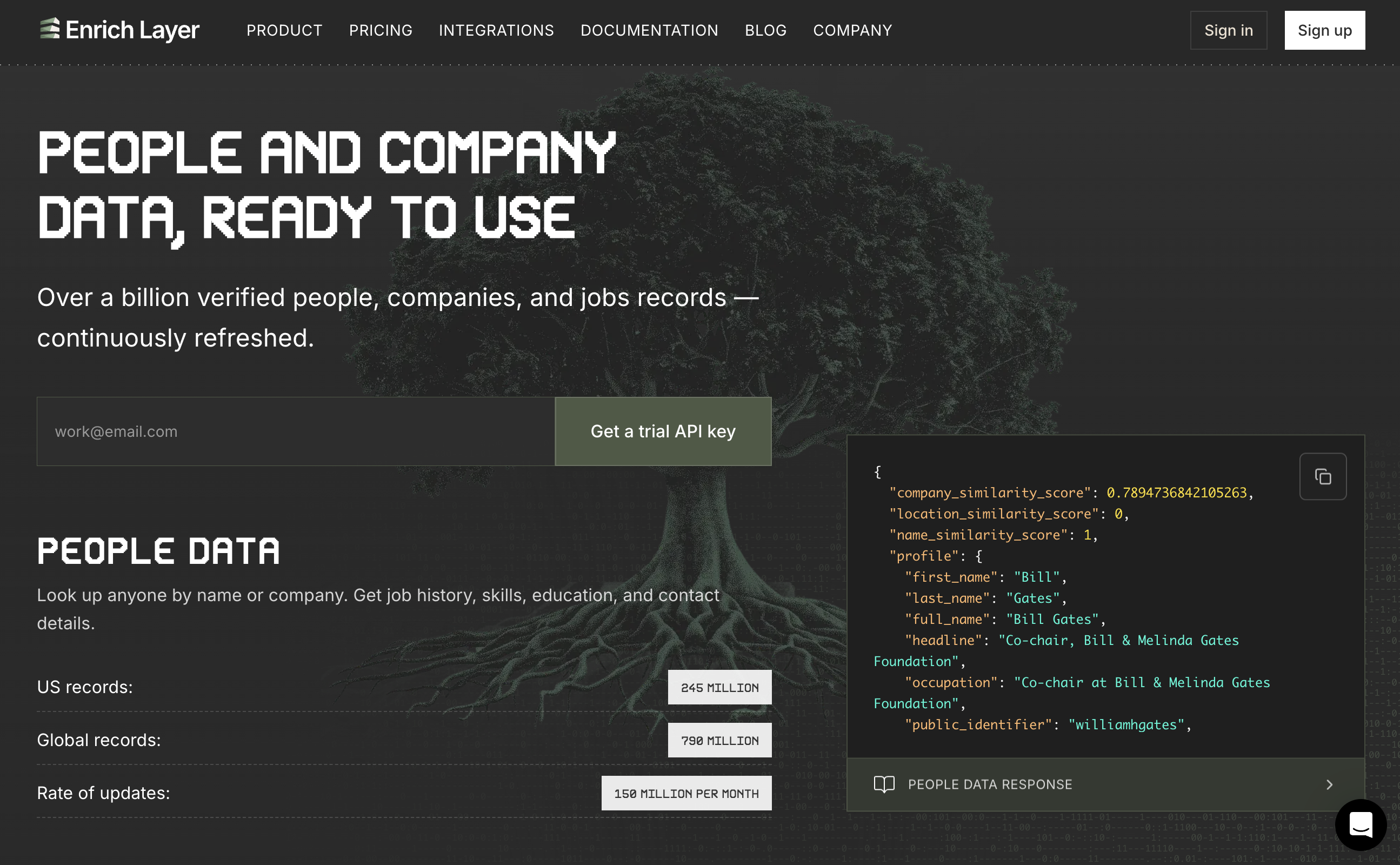
Enrich Layer provides people, company, jobs, contact, school, search, and logo APIs across 1.2 billion profiles and 50 million company records, on a shared credit balance. It became prominent after Proxycurl wound down in 2025 following litigation from LinkedIn, and it publishes a migration guide specifically for former Proxycurl users. For anyone drawn to MoltSets by the idea of a small, no-commitment entry point, Enrich Layer starts at $10 with no subscription at all.
Key Enrich Layer advantages:
- Genuine pay-as-you-go with no subscription required – $10 gets you started, with no contract and no monthly expiry on PAYG credits
- Proxycurl-compatible migration path, with documented transition guidance
- On-demand crawling rather than purely cached data
- Steep volume discount – roughly 11× from the $0.10 PAYG entry rate down to $0.009 on Ultra
- Seven APIs plus a CLI for scripts and CI pipelines
Enrich Layer pricing structure:
Pay-as-you-go, no commitment:
- $10 – 100 credits ($0.10/credit)
- $50 – 834 credits ($0.06/credit)
- $100 – 3,788 credits ($0.0264/credit)
- $500 – 20,834 credits ($0.024/credit)
- $1,000 – 46,297 credits ($0.0216/credit)
Subscriptions, all on a 12-month contract paid monthly, with credits issued monthly and expiring at the end of each cycle:
- Starter: $49/month – 2,500 credits ($0.020/credit)
- Growth: $299/month – 25,000 credits ($0.012/credit)
- Pro: $899/month – 89,900 credits ($0.010/credit)
- Ultra: $1,899/month – 211,000 credits ($0.009/credit)
- Enterprise: From $2,000/month
Note the endpoint costs: a Work Email Lookup is 3 credits, so 10,000 work emails a month needs 30,000 credits – more than Growth provides, pushing that workload onto the $899 Pro plan.
Enrich Layer limitations:
- No free tier – one of only two tools here, alongside LeadMagic, with no free entry point.
- Every subscription tier is a 12-month commitment, billed monthly but contractually locked, which is the opposite of MoltSets’ cancel-anytime model.
- Subscription credits expire every cycle. Credits are issued monthly and don’t carry over, so an under-used month is money gone. Only PAYG credits avoid this.
- Contact data is expensive in credits. Work Email Lookup costs 3 credits against 1 for a person profile, which is why an email-heavy workload lands on a far higher tier than the headline rates suggest.
- Corporate relationship to Proxycurl is not publicly confirmed – it offers a compatibility path, but whether the same entity operates it hasn’t been publicly established.
Enrich Layer reviews: No rating available – no G2, Trustpilot, or Capterra presence found.
Best for: Teams with existing Proxycurl integrations, and anyone who wants meaningful pay-as-you-go without a subscription or an application form.
Limadata Alternative: Limadata Starter
6. CompanyEnrich: Best budget option for company firmographics
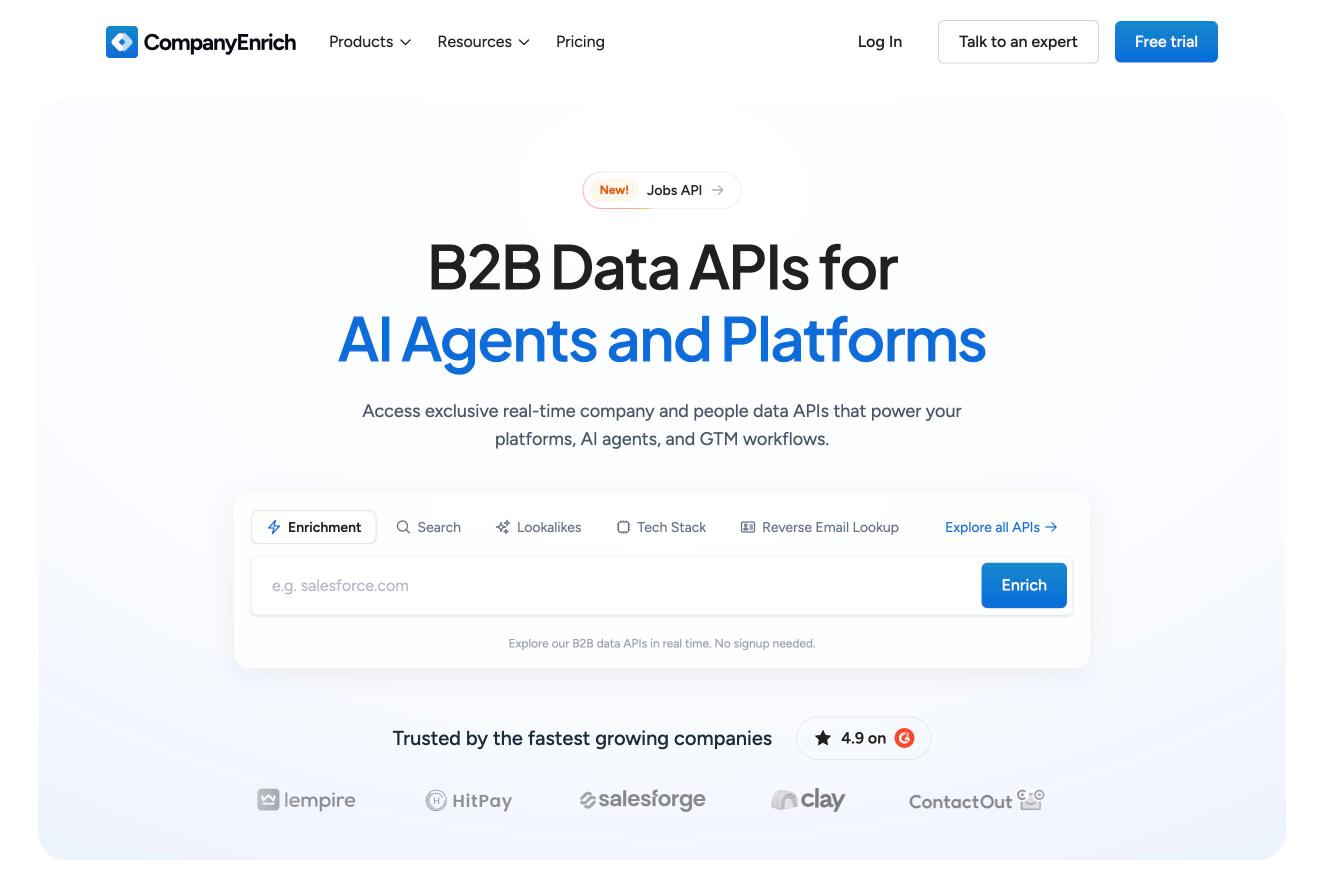
CompanyEnrich is an API-first company data platform covering roughly 30 million validated company profiles and 170 million people profiles, distilled from a much larger pool of raw records. The trade is deliberate: curation over raw volume. It offers full API access on every plan and runs its own MCP server. Where MoltSets is contact-first with company search attached, CompanyEnrich is the reverse.
Key CompanyEnrich advantages:
- Lowest cost per credit in this comparison at $0.0011 on the Scale plan
- Steep volume discount – 8.9× cheaper per credit from Starter to Scale
- Free Preview API returning up to 25 results without consuming credits, plus free autocomplete and logo endpoints
- 11 endpoints including funding, ad intelligence, jobs, headcount tracking, and reverse email lookup
- AI-powered lookalike discovery and semantic company search
- Full API access on every tier, with no feature gating below Scale
CompanyEnrich pricing structure:
- Free trial: 500 credits
- Starter: $49/month – 5,000 credits at $0.0098/credit
- Pro: $149/month – 50,000 credits at $0.0030/credit, with rollover
- Scale: $549/month – 500,000 credits at $0.0011/credit, with rollover, Preview API, async and batch endpoints
- Annual plans available but not published
CompanyEnrich limitations:
- Expensive contact data despite cheap credits. Find Email costs 10 credits and Find Mobile costs 30, so the low per-credit rate doesn’t translate to low contact costs. Ten thousand emails needs 100,000 credits, which only exists on the $549 Scale plan – 20× what MoltSets charges for the same job.
- No credit rollover on Starter – only Pro and Scale.
- Company-first. People data exists but is secondary; you may still need a contact provider alongside it.
CompanyEnrich reviews: 4.8/5 on G2 (29 reviews) – the highest verified average in this comparison.
Best for: Teams whose primary need is company firmographics, tech stack, and lookalike discovery at low cost.
Limadata Alternative: Limadata Starter
7. Explorium: Best multi-source data layer for GTM agents
Explorium positions itself as a B2B data layer for building GTM agents, aggregating from 50+ sources and delivering through an API, an MCP server on AWS Marketplace, bulk export, and native integrations. Its agent tooling is mature – the MCP server lets an agent select from roughly 30 enrichment categories rather than calling pre-mapped endpoints.
Key Explorium advantages:
- 50+ underlying data sources aggregated into one interface
- MCP server integrating with Claude, Claude Code, n8n, LangChain, LangGraph, CrewAI, and Zapier
- Free contact preview before committing credits
- Intent data alongside firmographics, which MoltSets doesn’t offer at all
- Custom signal creation and dynamic refresh
Explorium pricing structure:
- Free Trial: $0 – 100 credits, valid 90 days
- Starter: $99.99 one-time – 2,500 credits at $0.04/credit
- Growth: $749.99 one-time – 25,000 credits at $0.03/credit
- Scale: $7,499.99 one-time – 500,000 credits at $0.015/credit
- Enterprise: Custom
Explorium limitations:
- These are one-time purchases, not subscriptions. Packages are non-refundable, don’t auto-renew, and service stops when credits run out. Paid credits expire after 12 months with no rollover.
- Highest entry rate here at $0.04 per credit.
- Data freshness complaints. G2 reviewers report contacts shown as current at a company having already left, taking the email address stale with them.
- Inconsistent SMB coverage – reviewers note limited or outdated firmographics on smaller accounts.
- No granular contact billing – you can’t request only personal or only professional emails.
Explorium reviews: 4.6/5 on G2 (28 reviews).
Best for: Teams that want breadth across many sources for CRM enrichment, lead scoring, and intent-driven GTM agent workflows.
Limadata Alternative: Limadata Pro
8. Coresignal: Best for warehouse-scale bulk datasets
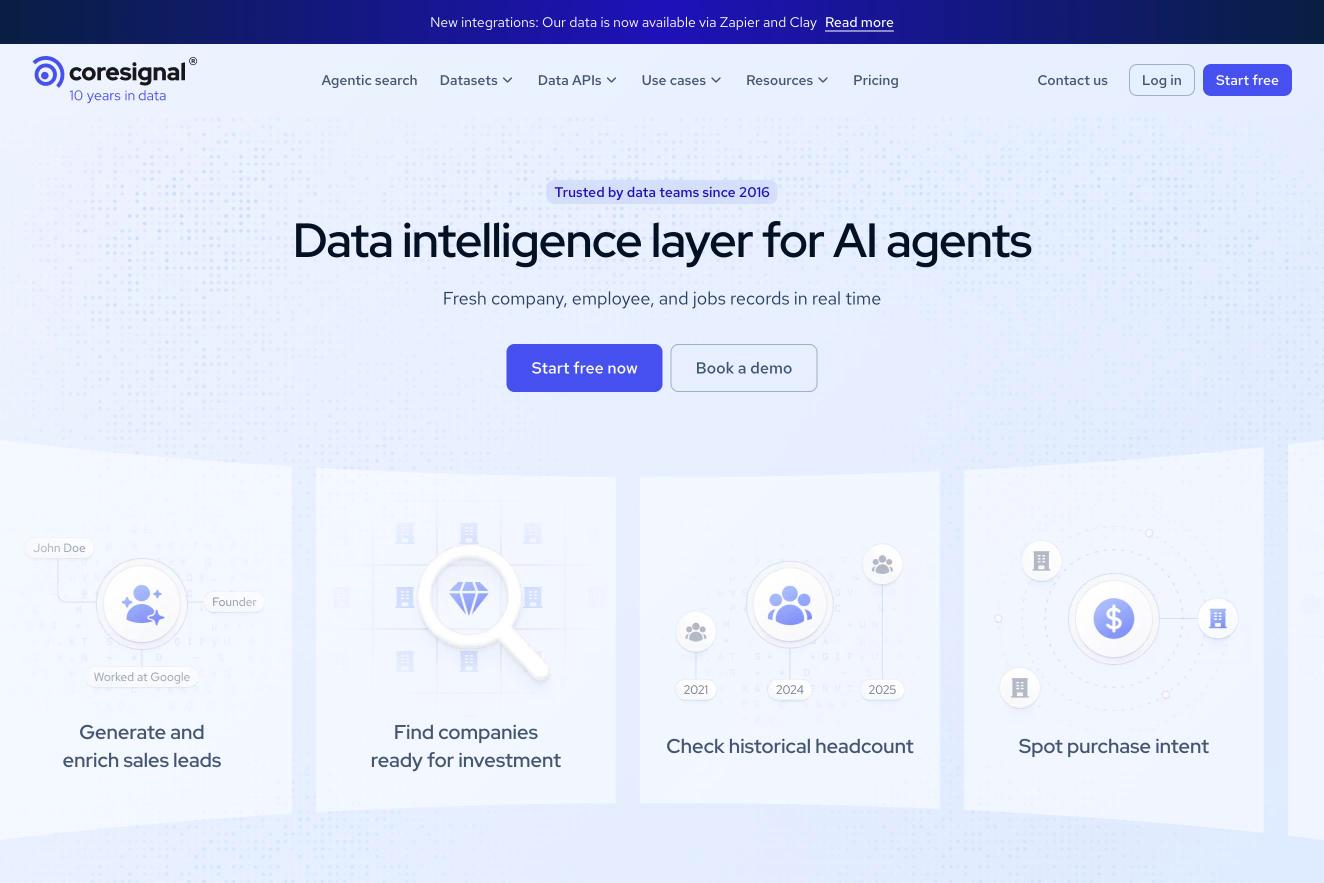
Coresignal aggregates public web data from 15+ sources into structured datasets covering companies, employees, and job postings – over 900 million employee profiles and 475 million job postings. It’s built for data engineering teams loading records into their own infrastructure, with Elasticsearch DSL querying and both API and flat-file delivery. If MoltSets’ weekly US-only snapshot isn’t deep or broad enough, this is the other end of the spectrum.
Key Coresignal advantages:
- Search is free. Elasticsearch DSL, semantic search, and filter queries consume no credits; you’re billed only on collect and enrich.
- Up to five years of historical data, which most competitors don’t offer
- Multi-source records that merge and deduplicate across providers
- Agentic Search API with both fast and reasoning modes
- Webhooks for change notification, plus a Historical Headcount API
- Certified by the Ethical Web Data Collection Initiative, with a documented public-data-only sourcing policy
- Eight tiers, so you can size the plan closely to actual usage
Coresignal pricing structure:
- Free trial: 2,000 credits, 7 days
- Mini: $49/month – 2,500 credits
- Starter: $199/month – 12,000 credits ($2,149/year for 144,000)
- Pro: $499/month – 35,000 credits ($5,389/year for 420,000)
- Growth: $1,000/month – 150,000 credits ($10,800/year for 1.8M)
- Premium: $1,500/month – 1,000,000 credits ($16,200/year for 12M)
- Scale: $3,000/month – 4,000,000 credits ($32,400/year for 48M)
- Elite: $5,000/month – 10,000,000 credits ($54,000/year for 120M)
- Datasets sold separately, from $1,000
Coresignal limitations:
- The entry plan is smaller than it looks. A base employee or company record costs 10 credits and a multi-source record costs 20, so Mini’s 2,500 credits buys 125–250 records a month – against 20,000-plus at MoltSets’ $27.
- Contact enrichment is gated to the $499 Pro plan and costs 20 credits per record, and Real-time Employee API is gated to Growth at $1,000.
- Rollover only on Premium and above for monthly plans – and the annual plans show no rollover at any tier.
- No built-in email verification, and users commonly report credits depleting faster than expected given the 10–20 credit record cost.
Coresignal reviews: 4.5/5 on Datarade. No G2 profile.
Best for: Data teams ingesting large volumes into a warehouse, and anyone who needs historical records or documented ethical sourcing.
Limadata Alternative: Limadata Enterprise
9. People Data Labs: Best for raw person data at scale
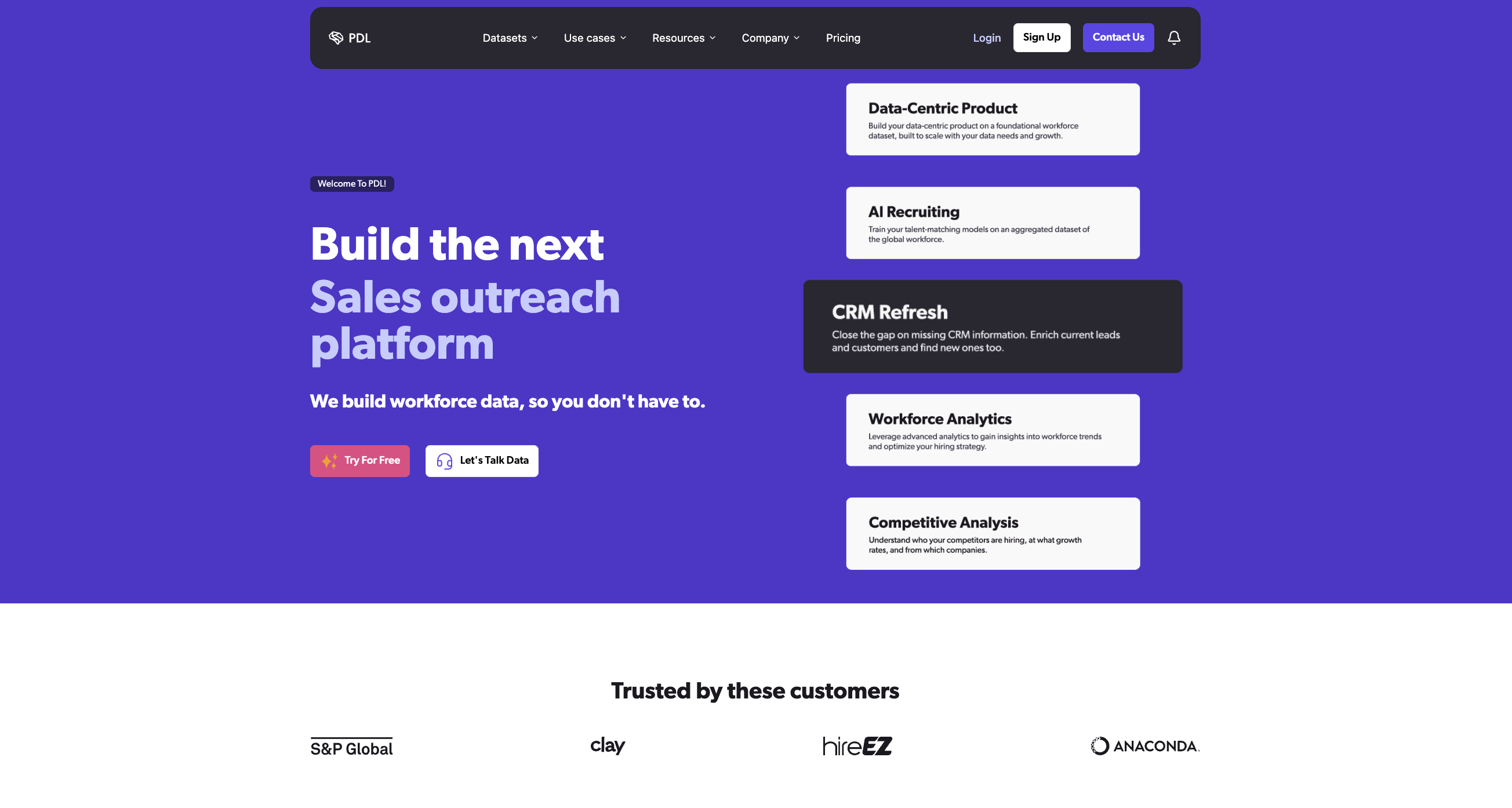
People Data Labs offers one of the largest person datasets available through an API – roughly 1.5 billion profiles and 74 million company records – with excellent documentation and a clean REST interface. It’s a developer’s data source rather than a GTM platform: no dashboard, no CRM connector, no workflow automation, which is a philosophy MoltSets users will recognise even if the pricing is a shock.
Key People Data Labs advantages:
- Very large person coverage with deep work history, education, and skills data
- Well-documented REST API with strong SDK support
- Free Autocomplete and Cleaner APIs that consume no credits
- Snowflake, Salesforce, and Databricks integrations
- Bulk enrichment consuming up to 100 credits in a single request
- Strong independent accuracy results in third-party field-yield benchmarking
People Data Labs pricing structure:
Person and Company data are sold as separate product lines, each with its own three tiers.
Person APIs:
- Testing (Free): $0 – up to 100 credits/month, no commitment. Contact data not included.
- Self-Serve (Pro): From $98/month, starting at 350 credits/month ($0.28/credit). Contact data included, premium field access, CSV enrichment, email support. Annual from $940.80 for 4,200 credits at $0.224/credit.
- Bulk Data (Enterprise): Custom pricing – annual contracts, all APIs, data license feeds, additional field bundles, designated success team, SSO/SAML.
Company APIs:
- Testing APIs (Free): $0/month – up to 100 monthly records, always free, ISO and SOC 2 Type 2 compliant data.
- Full APIs (Pro): $100/month, starting at 1,000 monthly records ($0.10/credit), premium fields, email support. Annual from $960 for 12,000 records at $0.08/credit.
- Bulk Data (Enterprise): Custom pricing – API or data license feeds, custom contract and usage terms, SSO/SAML.
Contact lookups through the Person Identify API are metered separately again, at $0.55 down to $0.50/credit monthly and $0.44 down to $0.40 annually. Enterprise is required above 100,000 credits.
People Data Labs limitations:
- By far the most expensive per credit here. The $0.28 entry rate is 28× Limadata’s Pro rate, and a single contact lookup costs more than a fifth of a MoltSets monthly plan.
- The free tier can’t be used to evaluate contact data. PDL’s Person free plan states plainly that contact data is not included, so you can inspect schema and coverage but cannot check whether the emails and phone numbers are any good until you’re paying.
- Person and Company are separate product lines, each with its own free, Pro, and Enterprise tiers – needing both means two subscriptions at $98 and $100/month respectively.
- Contact data is a separate, pricier meter through Person Identify, on top of enrichment costs.
- Self-serve caps out early. Ten thousand contact lookups a month exceeds the published tiers entirely and forces an enterprise conversation.
- Monthly refresh cadence – slower even than MoltSets’ weekly rebuild.
People Data Labs reviews: 4.3/5 on G2 (17 reviews).
Best for: Engineering teams building identity resolution or talent intelligence products where person-data breadth matters more than cost.
Limadata Alternative: Limadata Pro
10. MixRank: Best for enriching an existing B2B database at scale
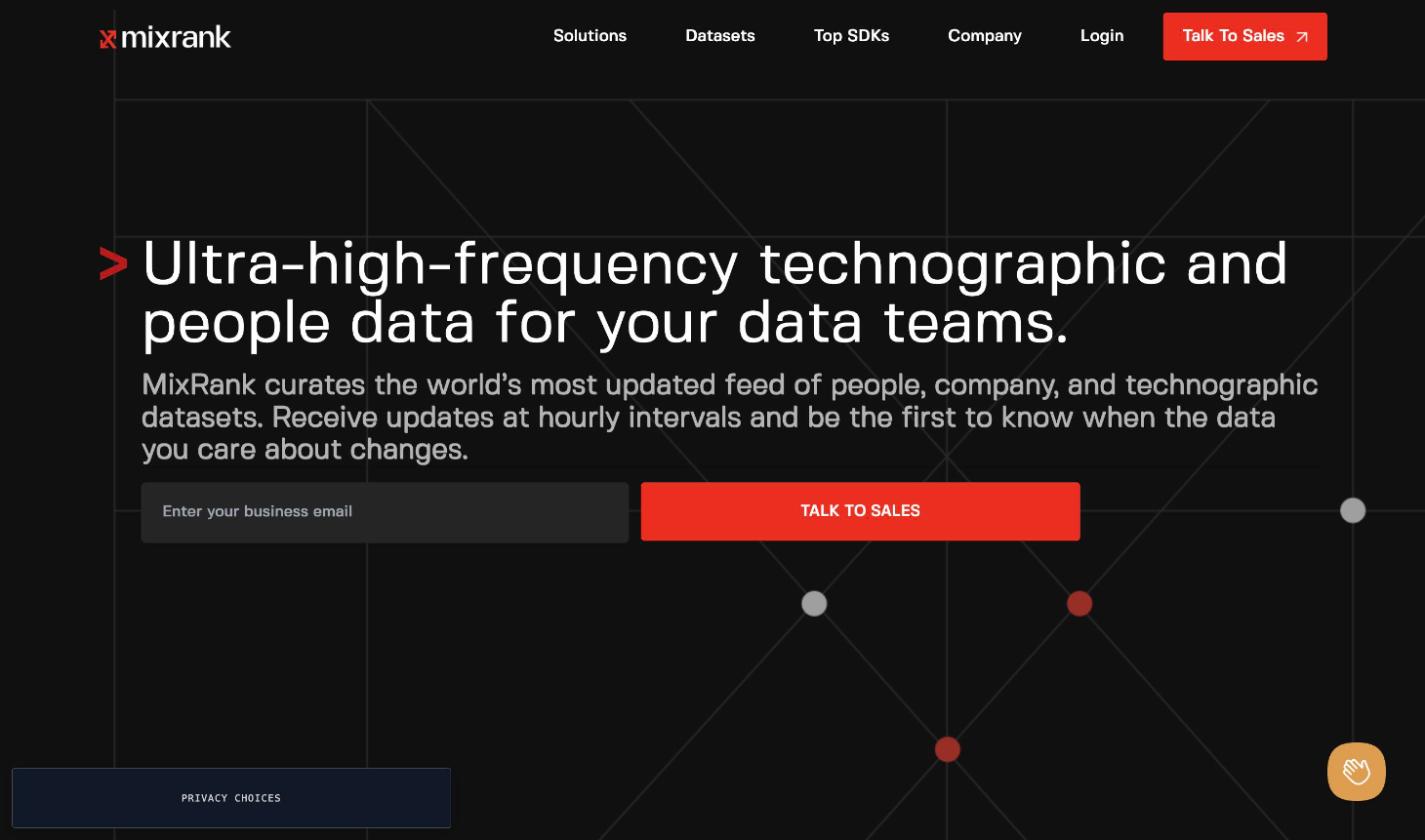
MixRank has been building B2B datasets since 2011 and sells to data teams enriching their own platforms rather than to end users. You connect an existing database and use MixRank as a source of truth – filling gaps, correcting errors, finding look-alike records, and keeping profiles current as people change jobs. It scans over 5 million profiles a day and processes roughly 3 petabytes a month, and its customer logos include Oracle, Meta, Intel, Amazon, and Adobe.
Key MixRank advantages:
- Cleanest per-record math in this comparison – one credit equals one operation equals one record, with no field multipliers
- 800M+ B2B records across 150+ data attributes, plus 70M companies indexed and 1.4B job posts
- Bidirectional mapping – email to social profile and back, website URL to company record and back
- Profile URL repair: MixRank records every URL transformation it observes, so broken or outdated profile links in your database can be corrected against it
- On-demand profile refresh through LiveScan, rather than waiting for a batch cycle
- Influence scoring on both people and company records
- Delivery by API, flat file, PostgreSQL tables, or a MixRank-hosted database, aggregated from 50+ sources
- Free data sample and API key with no credit card, so you can test coverage against your own records first
MixRank pricing structure:
Each endpoint is a separate subscription, on annual contracts:
- Enrich, Match, and Posts (identical pricing): 100,000 credits/month $1,000 · 250,000 $1,750 · 500,000 $3,250 · 1,000,000 $6,000 · above that, custom
- LiveScan: 100,000 credits/month $1,500 · 250,000 $3,000 · 500,000 $5,000 · 1,000,000 $8,000 · above that, custom
- Data Feeds and the Mobile Apps & SDK platform are quoted separately
MixRank limitations:
- Endpoints are billed separately. Enrich, Match, and LiveScan at entry volume together cost $3,500/month – $42,000 a year.
- $12,000/year practical minimum for a single endpoint on an annual contract. There’s no way to start small, which makes it the polar opposite of MoltSets commercially.
- No verified work email product, so it can’t serve contact-enrichment workloads. Match resolves an email to a record, which is reverse lookup, not email finding.
- Prices render client-side, meaning they’re effectively invisible to search engines and most third-party sources report figures from the wrong product line.
MixRank reviews: 3.8/5 on G2. TrustRadius scores it 5.8/10 on Sales Intelligence Data Standards.
Best for: Data teams enriching an existing contact or company database at scale, and platforms embedding licensed B2B data into their own products.
Limadata Alternative: Limadata Enterprise
Why Limadata Fits Real-Time AI Agent, Recruiting, and GTM Workflows
MoltSets solved a real problem: metered enrichment makes people afraid to let an agent run. That fear is legitimate, and flat-rate pricing is one answer to it. Published per-operation pricing is another, and it’s the one Limadata took – because it solves the same anxiety without giving up freshness, geography, or signals.
Published, per-operation pricing. Person enrich, company enrich, and work email each cost one credit. Web search and extraction cost 0.1. Mobile numbers cost 10. Those numbers are on the pricing page, which means you can model a workload to the dollar before signing up. An agent with a known per-call cost doesn’t need a cost cap any more than one with a flat rate does – it needs a number you can multiply.
Live data instead of a refresh cycle. MoltSets rebuilds its database every 7 days and processes job changes fortnightly. Explorium’s own reviewers report contacts listed as current who had already moved on; PDL refreshes monthly. Limadata fetches at query time from web crawling, registries, and partner networks, then cross-references across sources. A query-time model has no staleness window – the question isn’t when the database was last refreshed, it’s what’s true right now. For anything triggered by an event, that difference is the whole product.
Signals MoltSets doesn’t have. The Watch API fires webhooks on job changes, promotions, funding events, and hiring spikes. MoltSets is explicit that its surface is search, enrich, validate, and reverse lookup – there’s no event layer to migrate. If your workflow starts with “when X happens,” that’s a capability gap rather than a pricing difference.
Available today, everywhere. No application form, no waitlist, no US-only constraint. You can sign up, get a key, and call live international data in the time it takes to read this paragraph.
One data layer across three workloads. The same endpoints serve all three of the use cases this product is built for, which is why teams tend to consolidate onto it rather than run separate tools:
- AI agents – live enrichment at query time, an MCP server, and web search and extraction at 0.1 credits for RAG pipelines
- Recruiting – people search across 90+ attributes, personal email coverage ranked #2 in Clay’s waterfall, and Watch alerts that fire the moment a tracked candidate changes roles
- GTM – company search across 200+ attributes, verified work emails and mobiles, funding and hiring signals, plus hashed email and ad audience endpoints for paid targeting
Credit flexibility. Top-ups at 150% of plan rate mean a usage spike doesn’t force a tier upgrade – and unlike a weekly fair use cap, there’s no ceiling that simply stops you mid-run.
Frequently Asked Questions
Is MoltSets pricing really unlimited?
Not literally. MoltSets’ flat plans include unlimited enrichment records against its core dataset, but a published fair use policy caps them at 5,000 records a week on the $27 plan, 75,000 on the $97, and 900,000 on the $997, with search limited to half those figures. Converted to monthly volume that’s roughly 21,700, 325,000, and 3,900,000 records – and the first of those is almost exactly what Limadata’s 20,000-credit Pro plan allows at $200. The price gap is genuine; the volume ceiling is comparable. Records only count against your window when a call returns a real contact, which is a fair way to meter, but requests count either way. Mobile numbers sit outside the flat rate entirely, metered as phone tokens, because real-time carrier verification is a genuine per-unit cost. For capacity planning, use the weekly number rather than the word.
How fresh is MoltSets data, and does it matter?
MoltSets rebuilds its entire database every 7 days, which is better than People Data Labs’ monthly cadence or Crustdata’s monthly flat files. Two slower clocks run alongside it, though: job changes are processed every 14 days, and email validation dates can be up to 30 days old. Since B2B contact decay is mostly job-change driven, the fortnightly clock governs the failure mode that matters most.
Whether that matters depends entirely on what you’re building. For batch prospecting into cold outbound, it doesn’t – 7-day-fresh data is fine and the price is unbeatable. It matters in three places: CRM enrichment that persists as a system of record, event-triggered workflows that need to know that something changed rather than what’s currently true, and agent memory where an enriched fact gets cached and reused long after it was accurate. A periodic snapshot can’t express change events, so if your workflow starts with “when X happens,” you need a provider with a signal layer – Limadata’s Watch API or Crustdata’s watchers – rather than a faster refresh.
What is the best free MoltSets alternative?
Landbase offers the most generous no-strings free tier at 1,000 credits with no credit card and no expiry. Limadata’s free plan gives 100 credits with full endpoint access and returns real contact values rather than placeholders, which makes it the better option for genuinely evaluating data quality on a live, international dataset. MoltSets’ own free tier is 1,000 records lifetime, which is more than either but still requires beta approval to reach. Avoid judging a provider on People Data Labs’ free tier – its Person plan excludes contact data outright. Note that Enrich Layer and LeadMagic have no free tier at all.
Which MoltSets alternatives support MCP for AI agents?
Limadata, Crustdata, CompanyEnrich, Explorium, and LeadMagic all ship MCP servers. Limadata additionally supports Claude Code and Cowork; Explorium’s MCP server is distributed through AWS Marketplace and connects to LangChain, LangGraph, and CrewAI; LeadMagic includes MCP access on every plan including its cheapest. Landbase offers a CLI built for Claude Code and Codex workflows rather than an MCP server. If MCP-native access is why MoltSets appealed, you are not giving it up by switching.
Does MoltSets have international data?
Not yet. MoltSets launched with US data only and has stated an aim to add Europe/EMEA, Asia/APAC, and Canada by the end of Q3 2026. Until that ships, any non-US portion of your ICP needs a second provider. Limadata, Coresignal, People Data Labs, Enrich Layer, and Crustdata all have international coverage today, which for many teams is the single deciding factor rather than price.
Making the Right Choice
For most teams leaving MoltSets, Limadata is the answer: it keeps the API-first, no-seats model that made MoltSets appealing, and adds the availability, coverage, and freshness it lacks. The rest of this list earns its place on more specific workloads.
Choose by what you’re actually doing:
- Real-time enrichment for AI agents, recruiting, or GTM workflows → Limadata
- Live signals and event-triggered workflows → Crustdata
- Mobile-heavy contact work with predictable published costs → LeadMagic
- Conversational ICP definition and TAM mapping → Landbase
- Pay-as-you-go without a subscription or an application form → Enrich Layer
- Company firmographics on a budget → CompanyEnrich
- Multi-source data layer for GTM agents → Explorium
- Warehouse-scale bulk datasets → Coresignal
- Raw person data at scale → People Data Labs
- Enriching an existing B2B database at scale → MixRank
Before committing, run the same 500 records through two or three providers and compare match rate, field completeness, and cost per successful result. Nearly every vendor here has a free tier or trial that makes this cheap to do, and the results are frequently surprising – headline coverage numbers correlate poorly with performance on any specific ICP.
Two things are worth checking regardless of who you pick: whether you can actually get access to the plan you want, and whether your workload needs a signal layer rather than a faster refresh rate. For a growing share of AI-agent and recruiting use cases, the second question matters more than the price per record.
Pricing captured September 2026 from each vendor’s own pricing page. Vendors change pricing frequently – verify current rates before purchasing.