
Major Takeaways
Why do teams look for an Influ2 alternative? Not because person-based targeting doesn’t work. Influ2 pioneered it, and its support is highly rated. Teams leave over cost and match rate: there’s no public pricing and no self-serve plan, only 10–40% of an uploaded audience matched in our testing, and Influ2 doesn’t include a contact database, so you still pay separately to build the lists it targets.
How do these alternatives actually compare on price? Not by headline plan price, which hides what you’re actually buying. Normalized to the same job (getting 10,000 named contacts ready for ad targeting), tools with published pricing range from $200 to $1,000 a month. Vector starts at $36,000 a year on an annual contract, and Metadata.io and Influ2 don’t publish pricing at all.
When is Influ2 still the right choice? When you want a fully managed, person-based ad program and have the budget for it. If your team would rather not run audiences inside native ad managers, switching to save money can cost you the thing you were paying for.
Person-based targeting isn’t the problem. What sends teams looking is paying a premium to reach a fraction of their list: quote-only pricing, no self-serve option, low match rates, and a separate data stack needed to feed it. Here are the five strongest alternatives for person-level ad targeting, priced from each vendor’s own page.
Key Takeaways
- Cost and match rate are why teams leave Influ2. You can’t self-serve, can’t start free, and can’t price a program without a call, and the audiences you pay for match poorly once uploaded.
- Influ2’s match rates are the lowest in this comparison. In our testing, its audiences matched at just 10–40%, against 75–95% for Limadata, so much of the list you pay to target never sees an ad.
- Limadata is the strongest overall alternative for building person-level ad audiences, with best-in-class 75–95% match rates across major ad platforms, published per-credit pricing, and a free tier.
- Plan price is the wrong comparison. Some tools sell identifiers, some sell audience syncing, and some bundle ad management. Normalizing to 10,000 contacts changes the ranking substantially.
- Your list matters more than your targeting tool. Match rates depend on having current, match-ready identifiers, especially hashed personal emails for Meta and Google.
- Free entry points vary widely: Limadata and Primer have free plans, ContactLevel offers free LinkedIn ad analytics and a 14-day trial with 10,000 contacts, and Vector, Metadata.io, and Influ2 all require a sales conversation.
- Review volume is thin in newer tools. Several of these have fewer than 30 G2 reviews, so a free-tier test against your own contact list is worth more than any rating.
- Match the tool to the motion: outbound ABM, inbound-led retargeting, and fully automated campaigns are three different purchases, and no single vendor wins all three.
What Is Influ2 and Why Look for Alternatives?
Influ2 is a person-based advertising platform that helps B2B marketing teams target specific decision-makers within target accounts, instead of serving ads to everyone at a company. It’s a good product: it runs ads to selected people across LinkedIn, Facebook, Instagram, Google, Bing, and Amazon, and shows exactly who viewed or engaged with each message. The approach works. The problem is that you pay a premium, through a sales-led process, to reach only a fraction of the people on your list.
Key Influ2 strengths:
- Person-level targeting across major social, search, and display channels
- Named-contact engagement reporting that shows who saw and clicked
- Contact-level intent signals and buyer-journey sequencing
- Platform and ad fees bundled into one flat price, so there’s no separate media buy to manage
- Support that G2 reviewers consistently rate highly
Influ2 limitations:
- No public pricing and no self-serve plan. Pricing is quote-based on the number of people you target, with platform and ad fees bundled into one flat price. You can’t price a program without a sales call.
- Low match rates. In our testing, only 10–40% of an uploaded audience matched across major ad platforms, the lowest of any tool here.
- Premium price point. G2 reviewers place it in the highest cost tier, and one complains that each engaged contact costs a $5 credit.
- No built-in contact database. Influ2 targets the contacts you give it, so list-building and enrichment happen in a separate, separately paid tool.
- Stack sprawl. A typical Influ2 program also includes visitor identification, web personalization, list-building tools like Clay or Apollo, and outbound sequencing software.
- Reporting depth. Some G2 reviewers find the reporting structure limited and want deeper attribution.
Influ2 reviews: 4.6/5 on G2.
The practical problem isn’t the idea of person-based targeting. It’s that a marketer evaluating Influ2 can’t calculate what a program will cost, can’t test it without a sales process, still needs a separate data provider to build the audience, and then reaches only part of it. Every tool below solves at least one of those problems before you talk to anyone, and most solve more than one.
How We Compared These Tools
Every pricing figure came from the vendor’s own pricing page, captured October 2026, with ratings from G2. Where no public pricing exists, we say so rather than citing third-party estimates. Match rates are from our own testing where we could run audiences through a tool, alongside each vendor’s published figures.
Pricing pages change often, so verify before you buy.
Influ2 Alternatives at a Glance
| Tool | Best For | G2 Rating | Match Rate | Starting Price | Est. Cost for 10K Contacts |
|---|---|---|---|---|---|
| Limadata | Scaling ad audiences for agencies, growth teams, and ABM products | 5.0 | 75–95% | Free; paid from $50/mo | $200/mo |
| ContactLevel | Named buying committees | 5.0 | 50–75% | Free analytics; Audiences from $500/mo | $1,000/mo |
| Primer | Ready-made audiences synced to paid social | 4.6 | 30–60% | Free; paid from $800/mo (annual) | $800/mo (ad spend under $19K/mo) |
| Vector | Inbound-led contact audiences | 4.9 | 30–90% | $36,000/yr | Not published (usage-based) |
| Metadata.io | Automated campaign execution | 4.6 | 50–70% | Not published | Not published |
| Influ2 | Managed person-based ads | 4.6 | 10–40% | Not published | Not published |
Match rates are the share of an uploaded audience each tool got matched across major ad platforms in our testing. The last column prices each vendor on the same job: getting 10,000 named contacts ready for ad targeting, on the cheapest monthly plan that can actually deliver them. Only Limadata sells hashed emails per record; for the other tools, the figure reflects how their pricing applies to a 10,000-contact audience. Among tools with published pricing, that runs from $200 to $1,000 a month, a 5× spread. Vector starts at $36,000 a year, and Metadata.io and Influ2 quote every deal individually.
The 5 Best Influ2 Alternatives
1. Limadata: Best for building person-level ad audiences with best-in-class match rates
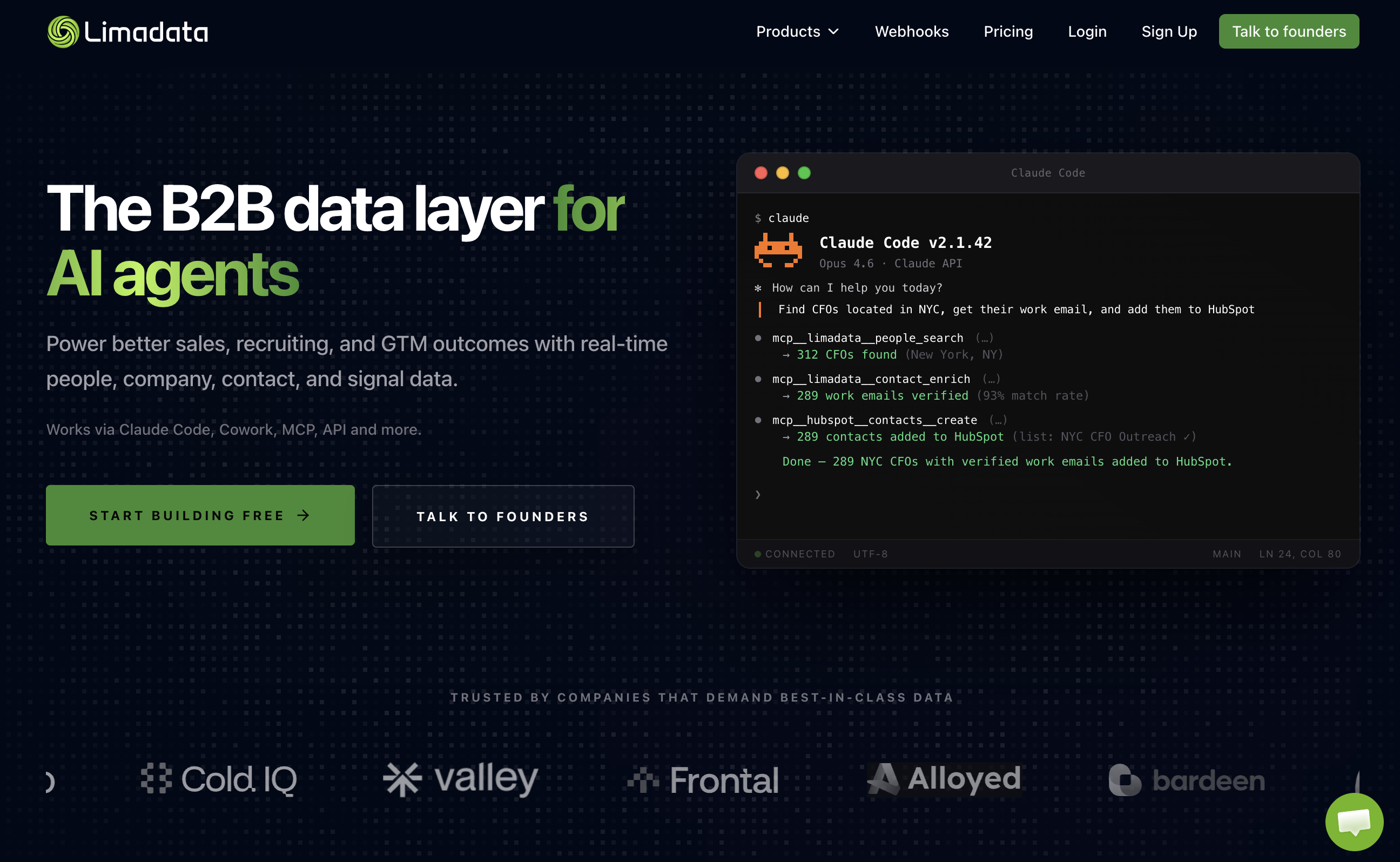
Limadata takes a different approach from every other tool on this list. Instead of locking your audiences inside a targeting platform, it gives you the raw material for person-level targeting (verified people data, contact details, and ad-ready hashed identifiers) so you can activate audiences in any ad platform you already use. Those identifiers match at 75–95% across major ad platforms, so more of the people you pay to reach actually see your ads. Because it queries multiple trusted sources at request time instead of serving records from a periodically refreshed database, job changes show up in your audiences quickly, not months later. Access is available through the API, webhooks, an MCP server, Claude Code, and Cowork.
Key Limadata advantages:
- Best-in-class match rates of 75–95% across major ad platforms, including LinkedIn, Meta, and Google
- Hashed email endpoint that turns a professional profile URL or work email into SHA-256 email hashes, ready to upload as a customer list
- Ad audience endpoint that returns hashed identifiers already formatted for a specific ad network
- Batch audience jobs that can resolve up to 100,000 profiles in a single asynchronous run
- Excellent personal email coverage, ranked #2 among personal email providers in Clay’s waterfall. This matters for ads because most people sign up for Meta and Google with personal addresses.
- 550M+ contacts and 60M+ companies, with people search across 90+ attributes for building target lists
- Watch API with webhooks for job changes and promotions, so audiences stay current when buyers move
- Success-based pricing: you’re only charged when a lookup finds a result
Limadata pricing structure:
- Free: $0/month, 100 credits
- Starter: $50/month, 2,500 credits at $0.02/credit
- Pro: $200/month, 20,000 credits at $0.01/credit, scalable to 100,000
- Enterprise: Custom, with batch endpoints, custom rate limits, and annual credit expiration
A hashed email lookup costs one credit per successful result, so 10,000 hashed emails fit within the Pro plan. Top-ups are available at 150% of your plan rate for months you run over. Full per-endpoint costs are on the Limadata pricing page.
Limadata limitations:
- It’s a data layer, not a campaign manager. You run bids, creative, and reporting inside your ad platforms or a separate tool.
- You need to be comfortable working with an API. Connecting the MCP server to Claude is enough to start building audiences in plain language, but if you want a point-and-click ad platform, this is a lower layer of the stack.
Limadata reviews: 5.0/5 on G2.
Best for: Teams scaling paid ads, including performance agencies, in-house growth teams, and ABM products that need a match-ready data layer behind their audiences on LinkedIn, Meta, Google, Reddit, or any platform that accepts hashed customer lists.
2. ContactLevel: Best for running ads to a named buying committee
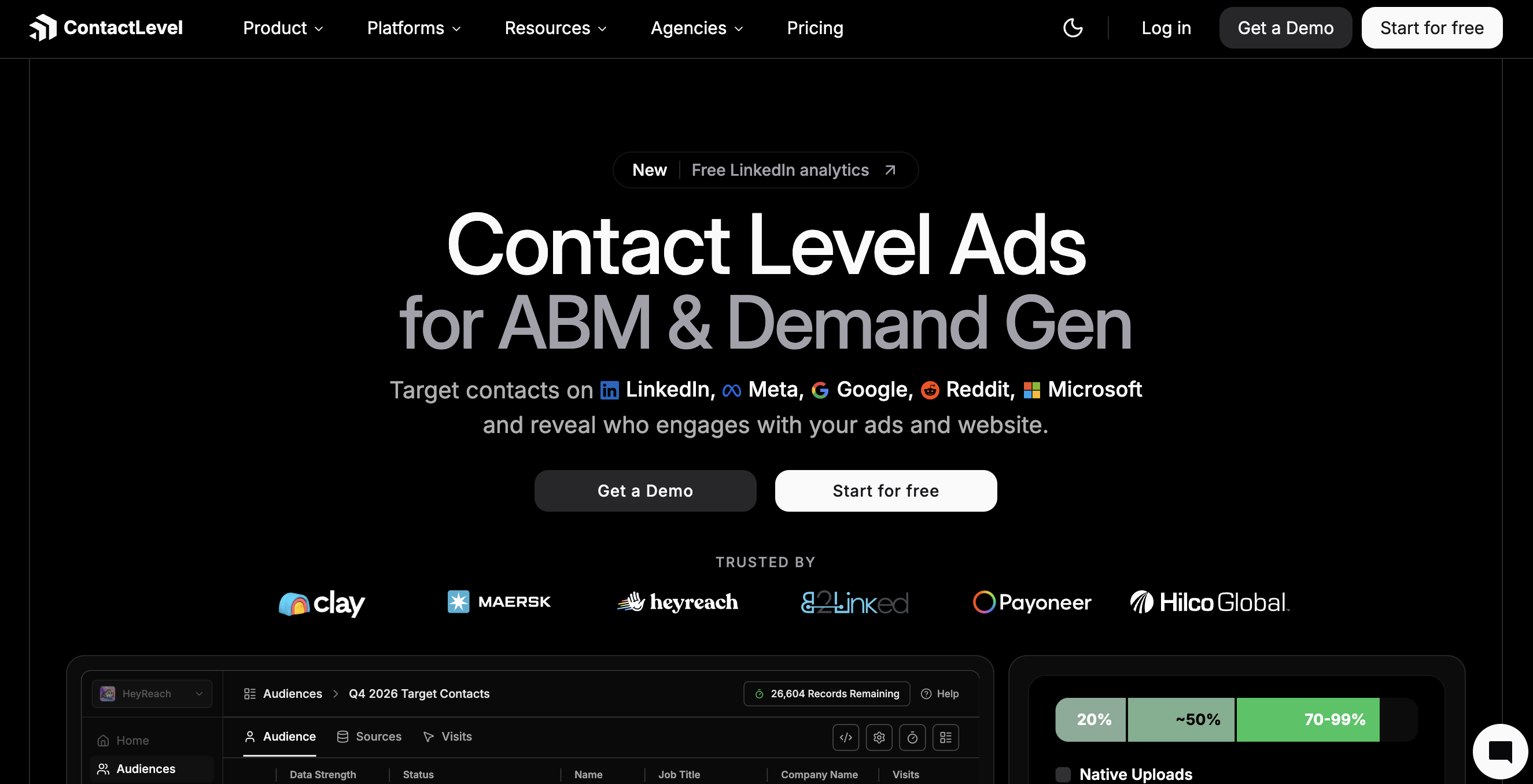
ContactLevel is the closest match to Influ2’s core use case: take a list of named contacts and get ads in front of as many of them as possible. Its Audiences product targets named contacts across LinkedIn, Meta, Google, Reddit, X, Microsoft, and ChatGPT, and advertises match rates of 70–99%, though in our testing audiences matched closer to 50–75%. You manage the resulting audience segments inside the native ad managers, so budget, creative, and bidding stay in your hands. Paired with a data layer like Limadata for list building, it covers most of what Influ2 does at a fraction of the cost.
Key ContactLevel advantages:
- Contact-level targeting across seven ad platforms from one list
- Real-time audience sync, unlimited audience segments, two-way CRM sync, and API access
- Free LinkedIn ad analytics that show which companies your spend actually reaches
- Optional Reveal product for identifying website visitors by name, title, and company
- No new campaign interface to learn: everything runs in native ad managers
ContactLevel pricing structure:
- Analytics: Free forever
- Audiences: From $500/month for 5,000 contacts, scaling to 30,000 contacts/month. 10,000 contacts/month is $1,000.
- Audiences, quarterly: $3,000 for 50,000 contacts upfront
- Audiences, annual: $10,000 for 200,000 contacts upfront
- Reveal (website visitor identification): From $199/month for 600 resolutions, up to $849/month for 12,500
- Trial: 14 days with 10,000 contacts, starting at your first audience sync
- Custom: Quotes available above the largest volume step
ContactLevel limitations:
- Match rates trail the marketing. ContactLevel advertises 70–99%, but our test audiences matched at 50–75%.
- It depends on your list. Like Influ2, ContactLevel targets the contacts you provide, so list quality and freshness determine results.
- Visitor identification costs extra. Reveal is a separate product with its own subscription.
- Interface still maturing. A G2 reviewer notes the UX/UI could use improvements, and another mentions that managing multiple organizations can be a challenge.
- Limited review history. Only two G2 reviews so far, so testing with the free trial is more informative than the rating.
ContactLevel reviews: 5.0/5 on G2.
Best for: Outbound-led ABM teams with defined account lists who want predictable, published per-contact pricing.
Limadata Alternative: Limadata Pro
3. Primer: Best for syncing ready-made B2B audiences to paid social
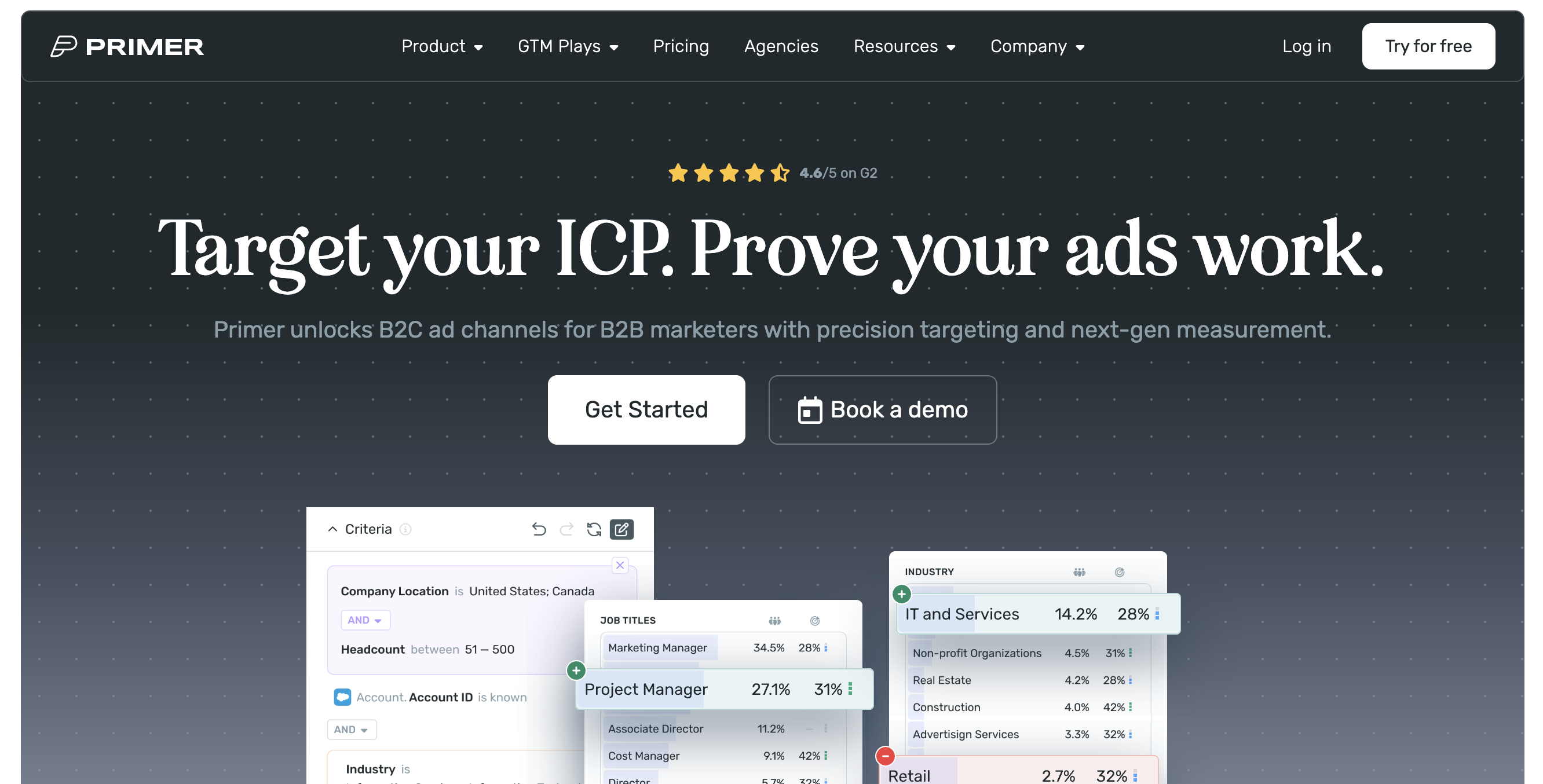
Primer builds precise B2B audiences and syncs them into your ad platforms. It combines its own B2B database with opted-in consumer identifiers such as personal emails, which is how it achieves higher match rates on channels like Meta and Reddit than work-email uploads alone. Audiences sync to LinkedIn, Meta, Google, Reddit, and more, with DV360, The Trade Desk, TikTok, X, and Bing available on higher plans.
Key Primer advantages:
- Built-in B2B database, so you don’t need a separate list-building tool
- Syncs with Salesforce and HubSpot or accepts CSV imports, with audiences refreshing automatically
- Holdout groups for measuring incremental lift, plus ad-clicker visibility
- Free-forever plan with website reveal and unlimited draft audiences
Primer pricing structure:
- Free: $0 forever. Includes draft audiences, website reveal, and database access, but audiences can’t be synced to ad platforms.
- Grow: $800/month billed yearly ($1,000 billed monthly), sized for $10–19K/month in ad spend on Primer audiences
- Scale: From $1,250/month billed yearly, with pricing tied to ad spend bands from $20K up to $399K/month
- Unlimited: Custom pricing, with no ad spend cap
- Add-ons: Extra CRM records at $150/month per 1M; Anti-ICP suppression audiences from $1,250/month
- Trial: A 30-day free trial starts when you sync your first audience
Primer limitations:
- Match rates are moderate in practice. Primer publishes 40–60% on Meta, 70–90% on LinkedIn, and 20–45% on Google, but our test audiences matched at 30–60% overall.
- Pricing scales with your ad spend, not your audience. Each tier covers a band of ad spend on Primer audiences, and exceeding it three months in a row moves you up a tier. As your paid budget grows, your Primer bill grows with it, even if you’re targeting the same people.
- It doesn’t manage your ads. Primer syncs audiences to your ad platforms, and you or your agency handle bids, budgets, creative, and optimization.
- Contact-level website reveal is US-only. Company-level reveal works globally.
Primer reviews: 4.6/5 on G2.
Best for: Mid-market B2B teams spending heavily on LinkedIn and Meta who want audiences built and synced from one platform.
Limadata Alternative: Limadata Pro
4. Vector: Best for turning website visitors into named ad audiences
Vector turns prospecting signals into contact-level ad audiences. You can sync contact lists from your CRM or use Vector to identify contacts showing intent on your site, then deliver them to B2B and B2C ad channels. Where Influ2 starts from a list you provide, Vector can start from buyers who are already visiting your site. It’s sold as a full platform covering signals, account scoring, journeys, advertising, and attribution.
Key Vector advantages:
- Identifies individual website visitors and syncs them as dynamic audiences to LinkedIn, Google, Meta, Reddit, TikTok, and X
- 30+ native buying signals and an account scoring model you can read
- Bid agent for automated campaign optimization, plus a Vector MCP server
- Unlimited seats on every plan, so sales and marketing can both use it without per-seat costs
- G2 reviewers consistently praise its ease of use and fast setup
Vector pricing structure:
- Annual contract only, starting at $36,000/year for a team running ABM on a few hundred target accounts
- Usage-based pricing: Signals, scoring, and advertising scale with target accounts, signal volume, and audience size. Journeys, attribution, sales alerts, integrations, and SSO are included.
- No free tier or monthly option. Exact pricing requires a demo.
Vector limitations:
- Annual contract from $36,000/year. With no monthly or self-serve option, it’s a significant commitment for smaller teams.
- Integration gaps. G2 reviewers mention integration issues and a clunky email integration process.
- Visitor identification is US-focused. One reviewer notes it isn’t available at the same level for Canadian visitors.
- Works best with high traffic. The visitor-driven model depends on having enough inbound volume to build meaningful audiences.
Vector reviews: 4.9/5 on G2.
Best for: US-focused B2B SaaS teams with strong inbound traffic and budget for an annual platform contract.
Limadata Alternative: Limadata Pro
5. Metadata.io: Best for automated campaign execution
Metadata.io is an AI-driven B2B advertising platform that builds audiences, creates ad creatives and landing pages, and sets up, runs, and optimizes campaigns across 12 channels, including Facebook, Instagram, LinkedIn, X, Reddit, Google, Microsoft Bing, and ChatGPT. Its focus is more on demand generation than on reaching specific named people, but its audience building and experimentation engine make it a strong option for teams leaving Influ2 who also want to automate campaign operations.
Key Metadata.io advantages:
- Audiences built from firmographic, technographic, and intent data
- AI agents that continuously optimize bids, budgets, and creative rotation
- Large-scale programmatic experimentation across 12 channels from one campaign brief
- Reporting that ties campaign spend to CRM pipeline outcomes
- G2 reviewers highlight its bid optimization and audience-building capabilities
Metadata.io pricing structure:
- No public price list. Pricing is scoped per team on a demo, based on channels under management, managed ad spend, and how much of the work you hand to Metadata: audiences only, campaign execution and optimization, or its fully autonomous AI workflow.
Metadata.io limitations:
- No public pricing. Every deal is scoped on a sales call, and price rises as you add channels or increase managed ad spend. Some users also say it’s expensive, with payment models that are hard for startups to fit into their budgets.
- Complexity. Smaller teams report a learning curve.
- Less precise at the named-individual level than Influ2 or ContactLevel.
Metadata.io reviews: 4.6/5 on G2.
Best for: Demand gen teams that want campaign execution and optimization automated, not just targeting.
Limadata Alternative: Limadata Enterprise
Why Limadata Fits Person-Level Ad Targeting Workflows
Across this comparison, three problems come up repeatedly: pricing you can’t calculate without a sales call, audiences built on stale contact data, and targeting platforms that still need a separate data provider behind them. Limadata was built to avoid all three.
Published, per-operation pricing. A hashed email costs one credit, and you’re only charged when a lookup succeeds. That means you can price a 10,000-contact audience before signing up, not after.
Live data instead of cached records. Data is fetched at query time and cross-referenced across sources. For ad targeting, this matters more than it sounds: when a buyer changes jobs, a stale list keeps paying to reach someone who no longer has budget authority. Paired with Watch alerts, audiences can be updated the moment a tracked contact moves.
Best-in-class match rates. Hashed work and personal emails, plus identifiers formatted for specific ad networks, are the inputs that actually drive match rates, and Limadata’s match at 75–95% across major ad platforms. Most targeting platforms expect you to bring these.
Pricing that doesn’t scale with your ad budget. Primer’s tiers rise with ad spend, and Metadata.io prices on managed spend. Limadata’s cost depends only on how many contacts you look up, so increasing your media budget doesn’t increase your data bill.
One data layer across your GTM motion. The same endpoints that build ad audiences also power outbound, CRM enrichment, and AI agents, which is why teams tend to consolidate onto it rather than paying for separate list-building and enrichment tools.
Works alongside any tool on this list. Limadata isn’t only an alternative to Influ2. It also makes ContactLevel, Primer, and native ad managers perform better by improving the list you feed them.
Frequently Asked Questions
What is the best free Influ2 alternative?
Influ2 has no free tier or self-serve trial, so several tools here are a step up on that count. Limadata’s free plan gives 100 credits with full endpoint access, which is enough to test hashed email coverage against a sample of your own target list. ContactLevel offers free LinkedIn ad analytics and a 14-day trial of Audiences with 10,000 contacts. Primer has a free-forever plan for drafting audiences and website reveal, with a 30-day trial that starts when you sync your first audience. Vector and Metadata.io, like Influ2, require a sales conversation.
What is person-level ad targeting?
Person-level (or contact-level) targeting serves ads to specific, named individuals instead of everyone at a company or everyone who fits a demographic profile. It usually works by uploading hashed identifiers, such as emails, which ad platforms match to their own users.
Why do hashed personal emails matter for B2B ads?
Ad platforms hash their own user data the same way you do, so uploaded hashed lists can be matched without either side seeing the underlying personal information. Personal emails matter because most people sign up for Meta and Google with personal addresses, so a list of work emails alone will match poorly on those channels.
Which Influ2 alternative is cheapest for 10,000 contacts?
Among tools with published pricing: Limadata at $200 for 10,000 hashed emails, Primer at $800/month on its Grow plan (as long as ad spend on Primer audiences stays under $19K/month), and ContactLevel at $1,000/month for 10,000 contacts. Vector’s pricing is usage-based and starts at $36,000 a year, while Metadata.io and Influ2 don’t publish pricing.
Can I switch off Influ2 without losing my audiences?
Your audiences are only as portable as the list behind them. If you’ve been sending Influ2 contact lists from your CRM, you can rebuild those audiences in any tool here or directly in native ad managers. The practical lesson is to keep your master target list and its identifiers in systems you own, so switching targeting tools means re-uploading a list rather than rebuilding it.
Making the Right Choice
The right Influ2 alternative depends far more on your go-to-market motion than on any overall ranking.
Choose by what you’re actually doing:
- Scaling person-level ad audiences with the highest match rates → Limadata
- Targeting a named buying committee with predictable costs → ContactLevel
- Syncing ready-made B2B audiences to paid social → Primer
- Turning inbound website traffic into ad audiences → Vector
- Automating campaign execution and optimization → Metadata.io
Before committing, run the same 1,000 target contacts through two or three options and compare match rate on each ad platform, cost per matched contact, and how quickly audiences refresh. Most tools here offer a free tier or trial that makes this cheap to do, and the results are often surprising: published match rates correlate poorly with performance on any specific ICP.
Two things are worth checking no matter which tool you pick: whether you own the audience list and its identifiers, and how often the underlying contact data refreshes. Those two questions account for most of the gap between the match rates teams expect and the ones they get.
Pricing captured October 2026 from each vendor’s own pricing page. Vendors change pricing frequently, so verify current rates before purchasing.